
When Hasan al-Basri was asked whether sadaqa was better than recitation of the Qur'an, he related the tradition: "A piece of bread and a handful of dates given in alms is more beneficial than reciting the Qur'an a thousand times."
Rumi
Pide Turkish Bayram Bread
Not to be confused with the pocket bread, pide is a sweet round loaf fragrant with sesame and fennel.
Total time 5 hours
Dough preparation 1/2 hour
Rising 2-1/2 hours
Baking 1 hour
Cooling 1+ hours
1 cup warm water, at skin temperature
2 tsp. yeast
3 tbsp. sugar
4 tbsp. butter
3/4 cup milk
4-3/4 cups all purpose flour
1 tbsp. salt Topping:
1 egg
1 tbsp. milk
3 tbsp. sesame seeds
1-1/2 tsp. fennel seeds
Sprinkle the yeast over the warm water in a small bowl. Melt the butter in a small saucepan over low heat, then stir in the milk and sugar and warm to skin temperature.
Combine the flour and salt in a large mixing bowl. Make a well in the center, then pour in all of the liquid ingredients. Stir until the mixture forms a dough that pulls away from the sides of the bowl. Turn out the dough onto a lightly floured surface and knead for 10 minutes or more, until the dough is smooth and resilient. Clean out the mixing bowl, butter it lightly, and return the dough to the bowl. Cover and let rise for 1-1/2 hours.
Punch down the dough, knead it briefly, then form it into a tight ball. Place the ball in the center of a lightly buttered 12" round baking dish, then flatten the dough until it covers all but 1" around the edge of the dish. Cover with a clean damp towel and let rise again for another hour.
Preheat the oven to 375?F.
Beat together the egg and milk, then gently brush it over the surface of the dough, the sides as well as the top. (Save any excess egg wash for another project.) Evenly sprinkle the sesame and fennel seeds over the dough, and pat them down gently with dry hands so that they will adhere to the egg wash. (Be careful not to deflate the dough. Using a sharp knife or razor blade, make several shallow cuts in a pleasing pattern over the surface of the bread.
Bake the loaf for 40 minutes, or until it turns a golden brown. Transfer to a wire rack to cool completely before serving.
from Serving the Guest: A Sufi Cookbook
Copyright © 1999, 2000 Kathleen Seidel
Saturday, October 22, 2005

Monday, October 17, 2005
Three Kunefe Versions
BURMA KÜNEFE 1 kg künefe 500 gr tuzsuz peynir 300 gr tereyağı 3 yumurta 1 avuç un Şurubu: 1 kg şeker üstünü örtecek kadar su Bir tepside künefe yağla karıştırılır. Altı eşit parçaya ayrılır. Küçük parmak kalınlığında açılır. İçine peynir konup poğaça gibi kapatılır. Diğer tarafta unla yumurtalar çırpılır, hazırlanmış peynirli künefeler bu bulamaca batırılarak yağda kızartılıp ılık şuruba atılır.
KAYMAKLI KÜNEFE 1 kg künefe 800 gr kaymak 300 gr tereyağı Şurubu: 1 kg toz şeker 1 kaşık limon suyu 3 bardak su 50 cm. çapında ince kenarlı bir tepside ortası açılıp tereyağı konulur. Hafif ateşte, yağ künefeye yedirilerek elle iyice kırılır. Ateşten indirilen künefe ikiye ayrılır. Yağlanmış tepsiye, künefenin yarısı, yarım cm kalınlığında sıkıca bastırılarak yerleştirilir. İnce ateşte çevire çevire altı pembeleşinceye kadar kızartılır. Üstüne kaymak döşenerek (kenarlara taşmamalı) bir tarafa bırakılır. Diğer yarı; başka bir tepsiye basılarak altı kızartılır ve üçüncü bir tepsiye çevrilerek, pişmemiş tarafı kaymağın yüzüne kızarmış tarafı da en üste gelecek şekilde kaymaklı tepsinin üstüne aktarılır. Hazırlanan şurup ılıtılarak sıcak künefenin üstüne dökülür. 8 cm’lik kareler şeklinde kesilerek ılık servis yapılır.
PEYNiRLi KÜNEFE 1 kg künefe 800 gr tuzsuz beyaz peynir 300 gr tereyağı Şurubu: 1 kg şeker Şeker üstünü kapatacak miktarda suyla kaynatılarak ağdalı bir şurup elde edilir. Ateşten indirmeden önce biraz limon suyu damlatılır. İnce kenarlı 60 cm çapında bir tepside künefenin ortası açılıp tereyağı konulur. Hafif ateşte yağ künefeye yedirilip elle iyice tiftiklenir. Ateşten indirilen künefe ikiye ayrılır. Aynı tepsiye biraz tereyağı sürülüp ayrılan künefenin yarısı yarım cm. incelikte yayılıp sıkıca bastırılır. Üstüne ufalanmış tuzsuz taze peynir kenarlara taşmayacak biçimde yerleştirilir. Künefenin diğer yarısı peynirin üstünü kapatacak şekilde yarım cm incelikte, düzgün bir biçimde yayılıp, sıkıştırılarak kuvvetli ateşin üstünde hafif hafif döndürülerek altı pembeleşinceye kadar kızartılır. Ayrı yağlanmış bir tepsiye alt üst edilir. Diğer tarafı da kızartılıp pembeleştikten sonra bir tarafa alınır. Üzerine hazırlanan sıcak şurup dökülür. Sıcak servis yapılır.
KAYMAKLI KÜNEFE 1 kg künefe 800 gr kaymak 300 gr tereyağı Şurubu: 1 kg toz şeker 1 kaşık limon suyu 3 bardak su 50 cm. çapında ince kenarlı bir tepside ortası açılıp tereyağı konulur. Hafif ateşte, yağ künefeye yedirilerek elle iyice kırılır. Ateşten indirilen künefe ikiye ayrılır. Yağlanmış tepsiye, künefenin yarısı, yarım cm kalınlığında sıkıca bastırılarak yerleştirilir. İnce ateşte çevire çevire altı pembeleşinceye kadar kızartılır. Üstüne kaymak döşenerek (kenarlara taşmamalı) bir tarafa bırakılır. Diğer yarı; başka bir tepsiye basılarak altı kızartılır ve üçüncü bir tepsiye çevrilerek, pişmemiş tarafı kaymağın yüzüne kızarmış tarafı da en üste gelecek şekilde kaymaklı tepsinin üstüne aktarılır. Hazırlanan şurup ılıtılarak sıcak künefenin üstüne dökülür. 8 cm’lik kareler şeklinde kesilerek ılık servis yapılır.
PEYNiRLi KÜNEFE 1 kg künefe 800 gr tuzsuz beyaz peynir 300 gr tereyağı Şurubu: 1 kg şeker Şeker üstünü kapatacak miktarda suyla kaynatılarak ağdalı bir şurup elde edilir. Ateşten indirmeden önce biraz limon suyu damlatılır. İnce kenarlı 60 cm çapında bir tepside künefenin ortası açılıp tereyağı konulur. Hafif ateşte yağ künefeye yedirilip elle iyice tiftiklenir. Ateşten indirilen künefe ikiye ayrılır. Aynı tepsiye biraz tereyağı sürülüp ayrılan künefenin yarısı yarım cm. incelikte yayılıp sıkıca bastırılır. Üstüne ufalanmış tuzsuz taze peynir kenarlara taşmayacak biçimde yerleştirilir. Künefenin diğer yarısı peynirin üstünü kapatacak şekilde yarım cm incelikte, düzgün bir biçimde yayılıp, sıkıştırılarak kuvvetli ateşin üstünde hafif hafif döndürülerek altı pembeleşinceye kadar kızartılır. Ayrı yağlanmış bir tepsiye alt üst edilir. Diğer tarafı da kızartılıp pembeleştikten sonra bir tarafa alınır. Üzerine hazırlanan sıcak şurup dökülür. Sıcak servis yapılır.
PEYNIRLI KUNEFE

PEYNIRLI KUNEFE
(SWEET SHREDDED PASTRY WITH CHEESE)
Sugar 2 1/4 cups 450 g
Water 1 1/2 cups 350 g
Lemon 2 teaspoons 10 g
Kadayif (shredded pastry) 500 g
Butter or margarine 1 cup 200 g
White cheese (un-salted) 1 2/3 cups 375 g
Combine sugar and water in a saucepan. Stir over low heat until sugar is dissolved. Boil gently for 5 minutes. Add lemon juice; stir. Boil for 1 minute. Set aside. Combine kadaylf shreds and melted butter in a pan. Break kadaylf shreds in butter blending well with tips of fingers. Divide into half. Spread one half in a slightly greased baking pan 25x25 cm (9x9 inch). Press with fingers slightly. Spread cheese over kadaylf shreds. Repeat the same with the remaining half, pressing firmly this time. Bake in a moderate oven for 30 minutes or until golden brown. Remove from oven. Let stand for 2 minutes. Pour warm syrup over. Cover and let stand until syrup is absorbed. Cut into 5-6 cm (2-2 1/2 inch) pieces. Arrange on a serving plate. Serve warm.
12 servings
Nutrition Value (Approx. per serving):
Energy ........: 516 cal Sodium ..........: 72 mg
Protein .......: 10.0 g Vitamin A .......: 334 iu
Fat ...........: 22.4 g Thiamin (Bl) ....: 0.04 mg
Carbohydrate ..: 68.8 g Riboflavin (B2)..: 0.03 mg
Calcium .......: 117 mg Niacin ..........: 0.71 mg
Iron ..........: 0.58 mg Vitamin C .......: - mg
Phosphorus ....: 158 mg
Zinc ..........: 1 mg Cholesterol .....: 7 mg
Regional characteristics:
This form of kadayif is usually served warm following a full meal. Cottage, Ricotta or cream cheese can be substituted for cheese.
Regional Cooking (Hatay)
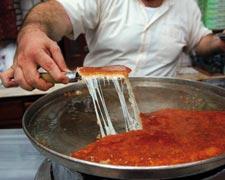 Kunefe
Hataylılar, kendilerine özgü yemeklerin üzerinde Antep ve Adana etiketi görmekten şikayetçi. Sac oruğu, firikli aş ya da turplu taratoru tanıtmak için adım atmış değiller; ama herkesi o çok meşhur künefenin izini sürmeye çağırıyorlar.
Hatay’da biber mevsimi gelip geçti. Çok değil, bir ay önce balkonların ahşap parmaklıkları kırmızı gerdanlıklarla süslüydü. Kadınlar, avlularda imece usulüyle ipe geçirdikleri biberlerin kışın ne güzel dolma olacağını konuşuyordu. Biberlerin bir kısmı İstanbul’daki akrabalara yollanmış olmalı, bir kısmı da Uzun Çarşı’da biber sıcaklarını kaçıran tedbirsiz kadınları bekliyor. Dolmadan başka közlemesi ve turşusu da yapılan kırmızı biber Hatay mutfağının vazgeçilmezlerinden. Ancak güneyin bu zengin mutfağını, Anadolu’nun diğer illerinden ayıran adı ve tadı farklı öyle lezzetler var ki, kırmızı biber küçük bir renkten ibaret kalır.
Sofra adabına uygun davranıp yemek öncesi getirilen; ama doyuruculuğuyla çoğu zaman sıcak yemeğe ihtiyaç hissettirmeyen salatalarla girelim söze; taze nane dalları, tereyağlı ve fıstıklı humus, dövülmüş kekikten oluşan zahter, cevizli biber, turplu tarator, küflü çökelek, patlıcanlı yoğurtlama, sarmaiçi... Küflü çökelek çok tüketilen; ama zor yapılan bir katık. Tarçın, yeni bahar, kimyon, sarımsak, zahter, toz biber, tuz ve zeytinyağı ilâvesiyle yoğrulan çökelek, topaklar halinde küflenmeye bırakılıyor.
Hatay mutfağının meşhurlarından biri de 300 yıldan beri keçi sütüyle yapılan tuzlu yoğurt. Haziran ayından sonra göçerlerin gelmesi ile geniş kazanlarda tuzla pişirilen yoğurtlar gece soğutulduktan sonra kavanozlara basılıp ağzı önce asma yaprağı sonra iç yağıyla korumaya alınıyor ve kilere kaldırılıyor. Kavanoz açıldığında ağzında kuruyan iç yağı atılıyor ve ilk yoğurtla katıklı ekmek yapılıyor. Sonrasında ise, kırmızı biber, nane ve zeytinyağı ilavesiyle kahvaltıda tüketildiği gibi, kumbursiye, yoğurt aşı gibi çorbaların yapımında, kabak, ıspanak, bakla gibi sebze yemeklerinde kullanılıyor.
Dörtyüze yakın yemek çeşidi barındıran Hatay mutfağında başrol oyuncusu her zaman tahin; ama pilav ve dolma çeşitleri özellikle de içli köfte yabana atılacak gibi değil. Biberli kimyonlu bulgur pilavı, baklalı bulgur pilavı, mercimekli bulgur pilavı, pirzolalı yaprak sarma, firikli aş, kuru dolma, analı kızlı, biberli ekmek, sac oruğu, Arap kebabı ve çiğ köftenin sofraya sultanlar gibi kurulduğu Hatay mutfağı ‘ağır’ ama besin değeri yüksek yemeklerden oluşuyor. Bol çeşit, damak zevki, besleyicilik ve lezzet esası üzerine kurulan bu kendine özgü mutfakta tasarruftan da ödün verilmediğini söylemek gerek.
Künefe akşam serinliğinde yenir
Peynir günü peynirli ekmek, tuzlu yoğurt günü kaymaklı künefe pişen evlerde, tuzlu yoğurt bulaşığı kapların çalkalanmasından elde edilen suyla tarhana aşı, sünük peynirden arta kalan peynirli suyla kâke yapılır ve yağ bulaşığı kaplarda bulgur aşı pişirilir. Hatay mutfağını yaşatan kadınların maharetinden söz etmeye gerek yok; ancak kasapları ve fırıncıları unutmak ayıp olur. Evde, ıspanak, tuzlu yoğurt, kıyılmış soğan, çökelek, toz biber ve zeytinyağından hazırlanan ‘iç’ten katıklı ekmek yapmak ancak mahir fırıncıların harcıdır. Antakya kasapları ise, etin satın alındığı, pişirildiği ve hemen oracıkta kebap olarak tüketildiği enteresan mekânlardan...
Tatlılar bahsini reçellerle açıp ardından künefeye geçmeli. Antakya’da sadece meyvelerin değil sebzelerin de reçeli yapılıyor. Hemen her yörede bilinen çilek, kayısı, vişne, erik ve incir reçellerinden başka ceviz, kabak, patlıcan ve turunç da hem tatlı hem de reçel olarak kahvaltıları zenginleştiriyor. Ev reçelinden para kazanmak henüz o kadar yaygın değil; ama eski Antakya evlerinden birinde reçel kaynatan Maria Saati’nin ünü bu hızla yayılmaya devam ederse o büyük tencereler her evde kaynamaya başlayacak. Mahallenin çocukları, avluda reçel kavanozlarıyla objektife gülümseyen Maria’ya sesleniyor: “Maria Tezye, yine çekim mi var?”
İstanbul, Ankara ve İzmir’den gelen turist grupları beraberlerinde sadece reçel değil, nar ekşisi, dut şurubu, yaprak sarması ve içli köfte de götürüyor. Antakya’nın en özgün tatlılarından künefe ise Köprübaşı’nda yeniyor. Öğlen sıcağında kimsecikler ortada görünmüyor; ama akşam serinliğinde, yemeği yiyen aileler dışarıdaki masalarda yerlerini alıyor. Künefe hareketliliği gece yarısına kadar devam ediyor. Ferah Künefe’nin hem sahibi hem de ustası Zeki Cüzdan, babasından aldığı mesleği, dükkânda arı gibi çalışan oğluna devretmeyi planlıyor. Ona göre bu işin sırrı, halis niyet ve müşteriye hizmette. Zeki Usta her işte olduğu gibi künefede de sahtekârlık yapıldığını söylüyor. Bu tatlı için özel hazırlanan tuzsuz peynir yerine suda bekletilen tuzlu peynir kullananlar mesleğin yüz karaları. Bu arada canı künefe çekenlerin ille de Antakya’ya gitmesi gerekmiyor. Zeki Usta, hesap numarasına para yatıran herkese ister kargoyla ister otobüsle künefe gönderiyor. Ortadoğu ülkelerinde hayli yaygın olan meyve sularının Antakya’daki tek temsilcisi Ali Haydaroğlu. Yirmi yıldır meyvecilik yapan Haydaroğlu, bir Dubai ziyaretinden meyve suyu sıkma makineleriyle dönmüş. Şimdi tek amacı, Antakyalıları taze meyve suyuna alıştırmak. Hemen söylemeli ki böyle bir alışkanlık kazanmak için Haydaroğlu’nun hazırladığı bir bardak kokteyli içmek yeterli olacaktır. O tek bardağın içinde süt, elma, kavun, şeftali, armut, üzüm, vişne, muz ve bal olduğunu söylersek durum anlaşılmış olur. Köprübaşı Hürriyet Caddesi’ndeki 2 metrekarelik dükkânın devamlı müşterileri arasında doktorlar var.
HATAY MUTFAĞI NİYE YOK SAYILDI?
Mutfak konusunda Hataylılara bir dokunun bin ah işitin. Kendilerine özgü birçok yemeğin yakın şehirlere mal edilmesine içerleyen akademisyenler, düzenledikleri ‘Hatay Mutfağı Sempozyumu’nda, tanıtım eksikliğinden yakınıyorlar. Hatay’la ilgili kitaplar yazan Mehmet Tekin, Hatay mutfağının Antep ve Adana mutfağının gölgesinde kalmasını şöyle açıklıyor: “Hatay, Türkiye’den 20 yıl ayrı kalmış, bu süre içinde mutfak konusunda güney illerimizi Adana, Antep ve Urfa’nın kebapları, yemek çeşitleri ve tatlıları temsil etmiştir. Vatana katılmayı bekleyen Antakya ve havalisinin adı, mukaddes bir yurt parçası, bir sembol olarak ikinci planda kalmıştır.” Araştırmacı Tekin, Hatay mutfağının ne kadar köklü olduğunu, çok eski yıllarda şehri ziyaret eden şair ve yazarların eserlerine dönerek ispatlıyor. 1899-1967 yılları arasında yaşayan Cemil İpek’in ‘Yemek Mevlidi’ Hatay’a özgü 13 çeşit yemekten bahsediyor. 1930’lu yıllarda Antakya’yı ziyaret eden Pierre Bazantay da ‘Antakya Zanaatları Üzerine Anket’ adlı kitabında, yemeklerden başka o yıllarda yörede pişirilen altı çeşit ekmeği anlatıyor. Tekin, tost ve hamburgerle beslenen gençleri uyarmayı da ihmal etmiyor: Antakyalı olmak istiyorsanız şehrin mutfağından beslenin.
Friday, July 29, 2005
The Tastes and Smells of Byzantium
Monday, March 03, 2003
Food
The Tastes and Smells of Byzantium By Andrew Dalby
Sovereign over all others
Byzantium in its heyday was one of the wonders of the world. Here is a Crusader of the year 1204, recalling his first glimpse of the medieval metropolis from across the Sea of Marmara:
Those who had never seen Constantinople before were enthralled, unable to believe that such a great city could exist in the world. They gazed at its high walls, the tall towers with which it was fortified all around, its great houses, its tall churches more numerous than anyone would believe who did not see them for himself; they contemplated the length and breadth of the city that is sovereign over all others. Brave as they might be, every man shivered at the sight.
— Geoffroi de Villehardouin, The Capture of Constantinople, section 128
Eighteen hundred years earlier, about 660 BCE, a Greek colony had been established at this magnificent site; known as Byzantion, it was already famous in legend. The Argonauts had passed this way, in one of the best-known of Greek mythological tales, on their way to the land of the Golden Fleece; they had navigated the Bosporus and dodged the Symplegades or “Clashing Rocks.” In historical times, Byzantion became rich on its trade routes and tuna or bonito fisheries. It had so much to offer that Constantine I, the first Christian emperor of Rome, selected it in 330 CE as his new eastern capital, the second Rome. He renamed it Constantinople, and, as such, the venerable city was destined for a millennium of worldwide fame as capital of the later Roman or “Byzantine” empire.
Simple tastes and exotic aromas
But what were the tastes and smells of medieval Byzantium? We know some of those tastes because they are still popular today. Let us begin with Justin I, father of the great Justinian, founder of a new dynasty. He emerges into history as a young peasant, one of three friends from Illyria who set out to walk to the capital to join the army: “They covered the whole distance to Byzantium on foot, and when they arrived they had nothing at all in their knapsacks except what was left of the twice-baked bread that they had packed at home” (Procopius, Secret History, section 6.2). That “twice-baked bread” was paximadi: thick slices of barley bread, baked until it is bone-dry and almost bone-hard, still the basis of many a simple Greek meal. Lightweight, long-lasting, and nourishing, those paximadia were ideal supplies for three poor medieval hikers.
We can still enjoy capers as a starter, as Byzantines did, with a sauce of oil and vinegar or (as they preferred) vinegar sweetened with honey. We can also still eat dried figs and walnuts before a meal, as Byzantine physicians recommended — whether or not we take this snack as an antidote against possible poisoned dishes to follow. We can consider the dietary instructions of the imperial physician, Simeon Seth, in Properties of Foods (p. 125) — “Botargo is to be avoided totally!” — and, like many of his contemporaries, reject his advice. Botargo, incidentally, is salted gray mullet roe: it remains a costly delicacy, and my advice is to go for it!
We can re-imagine the taste of the kolymbades, green olives swimming in brine, which so many Byzantines enjoyed. When taking a sip of ouzo, we are happy to recall that the people of Byzantium were advised by Hierophilus and other physicians to drink anise wine (the true ancestor of ouzo) in April and an anise-flavored aperitif in June. If we take a spoon sweet, it is pleasant to remember that, a thousand years ago, at least two Byzantine authors enjoyed to dia kitriou, “the citron conserve,” made with citron peel, honey, and carefully chosen spices.
We can easily picture ourselves shopping in the markets of Byzantium for fine raisins from Chios, Vlach mountain cheese, sweet Cretan wine, and malmsey wine from Monemvasia (both of which fetched high prices all over Europe). We can almost hear the salesman hawking his xinogalo through the streets, “Eparete droubaniston oxygala, gynaikes!” (“Buy your buttermilk from the churn, ladies!” Prodromic Poems, number 4, line 112) We can imagine selecting from the butcher’s counter “two three-year hens freshly killed and sleek: the butcher had loosened the fat of their bellies and tucked their legs into it” (Timarion, section 46). We can almost recall an encounter with Saint Simeon “the Fool,” wandering through the streets with a string of sausages around his neck like a garland of flowers and a pot of mustard in his left hand to dip each sausage before he ate it.
We know some of the exotic aromas of Byzantium because we can still sense them among the spice stores of modern Istanbul and Athens. Many were already familiar under the Roman empire: saffron, black pepper, cinnamon, ginger, and cloves. Even musk had reached Europe by late Roman times: “It is a scent for lovers and hedonists,” said the Christian translator, Saint Jerome, disapprovingly. We must, however, appeal to two Byzantine authors to pin down for us, for the first time, the origin of this wonderful perfume. “The best musk comes from a city east of Afghanistan called Toubata,” writes Simeon Seth (Properties of Foods, p. 66). He was right: musk does come from Tibet (which, however, is not a city). How was it found? The Byzantine trader, Cosmas Indicopleustes, gives the answer pictorially, in the manuscript of his strange memoir entitled Christian Topography, with a pen-and-ink sketch of a huntsman aiming an arrow at a fleeing musk deer.
Other aromas did not apparently reach Europe until early medieval times: ambergris from the shores of the Indian Ocean, camphor from Borneo, jasmine from Iran, nutmeg from the Banda islands in eastern Indonesia. The Byzantines were the very first Westerners to encounter these heady aromas, and they are still familiar to us today, if not in food, then at least in perfumes and cosmetics. Others known to Byzantine physicians and perfumers — like cubebs, galanga, storax, and zedoary — are now almost forgotten after their medieval heyday.
Imperial blends
Did Byzantium care about its foods and aromas? We can begin to answer this question by pointing to the Prodromic Poems, which claim to be the work of a poor, hungry, greedy, scholarly monk. Whoever really wrote these lively diatribes was a lover of fine food:
First come the baked fish, the little pisi in their stew. Second, the saucy dish, a hake weighed down with savory sauce. Third, the sweet-and-sour, the saffron dish, with spikenard, valerian, cloves, cinnamon, and baby mushrooms, and vinegar and unsmoked honey, and in the middle of it a big golden gurnard and a gray mullet, three hands’ breadths, with the roe, fresh from Region harbor, and a fine, well grown, first quality bream — O let me munch on the bits in the bowl, let me sup at their sauces, let me make off with four cups of the Chian wine, let me find a sufficiency, let me be satisfied! Fourth the grill and fifth the fry-up…a flounder, nicely grilled on its own, with fish sauce, sprinkled from top to tail with caraway; and a steak from a big sea bass. (Number 3, lines 147-163)
Now look over the head of the Prodromic poet at the imperial throne that he sometimes dared to address. There is evidence that flavors and aromas preoccupied even the emperors themselves. The Book of Ceremonies, compiled at the command of emperor Constantine Porphyrogenitus, lists a whole range of items to be stocked in the imperial apartments: “ointments, various incenses, fumigations: mastic, frankincense, sugar, saffron, musk, ambergris, aloes and dry aloeswood, true cinnamon of first and second grades, cassia and other aromatics” (p. 468).
The patriarchs were anxious to distance the spice trade (and other trades) from the great church of Saint Sophia. “One must not establish a shop within the sacred precincts or display foodstuffs or conduct other sales,” they instructed; “note that this Canon relates to those who trade in the perfume shops and barbers’ shops around the most holy Great Church, and even more so inside it. These deserve severe punishment,” they impotently repeated (Canons of the Council at Trullo, section 76). The emperors, by contrast, were apparently glad of the proximity of the perfumers, directing that their stalls be placed in a row between the miliarion (milestone) and the revered icon of Christ that stood above the Bronze Arcade, so that the perfumes might waft upward to the icon and at the same time fill the vestibule of the royal palace.
If I’m not mistaken, Byzantium can show us not only the first imperial perfumer in the world, but also one of the first imperial cooks. I mean both those phrases literally. The perfumer was Zoe, the eleventh-century empress who was an enthusiast for “the most Indian” of substances (a curious phrase, but that is how Michael Psellus puts it in his court memoirs) and for spicy aromatic woods like sandalwood and aloeswood. “Her only hobby,” Psellus adds, “was to blend perfumes and to make aromas. Her private apartment was just another of those workshops off the marketplace complete with perfumers and distillers: she had braziers set up all round it, and her maids were employed in weighing, blending and the rest of it.” And the imperial cook? That was Zoe’s predecessor, Constantine VIII, who “had a strong stomach and a constitution well able to withstand anything he ate. He was a highly skilled mixer of sauces, seasoning his dishes with colors and flavors so as to arouse the appetite of all types of eaters. He was ruled by food and sex,” Psellus concludes (Chronographia, Book 6, sections 62-64, and Book 2, section 7). As he well knew, it had been a commonplace among ancient philosophers that these two sensual indulgences always go together.
Even more engaging than either of these two hobbyists was the emperor who cared about Byzantium’s street food: the great but unlucky Manuel (1143-1180), whose diplomacy and dynastic alliances spread the empire’s influence far and wide, but whose military disaster at Myriokephalon signaled the loss of Anatolia to the Ottomans. Returning from Blakhernai one evening, Manuel noticed the old women selling street food (“enodios edode” is the fine classical phrase coined for the occasion by his historian, Nicetas Choniates). Manuel “suddenly felt like a bowl of hot soup and a bite of cabbage. Anzas, one of his entourage, advised that they had better wait and control their hunger: there would be plenty of proper food when they returned to the Great Palace. Manuel said sharply that he would do exactly as he pleased. He went straight up to the market woman’s bowl, full of the soup that he fancied. He drank it down greedily and had several mouthfuls of greens on the side. Then he took out a bronze stater and handed it to one of his people. ‘Change this for me,’ he said. ‘Give the lady her two oboloi, and don’t forget to give me back the other two!’” (Chronicle, p. 57)
Reading about Byzantine foods and flavors
If you read Greek, there’s plenty to read. The late Christos Motsias’s Ti etrogan oi vyzantinoi is still available from Ekdoseis Kaktos. In 1994, a lecture by Johannes Koder was translated into Greek under the title, O kipouros kai i kathimerini kouzina sto Vyzantio, and published by the Goulandris-Horn Foundation in its series, Opseis tis vyzantinis koinonias. Of course, there is still the massive work by Phaidon Koukoules, Vyzantinon vios kai politismos, published in several volumes between 1947 and 1955.
If you only read English, there is less to suggest. You will find only 15 pages about Byzantine food in my Siren Feasts; I’m the first to admit that’s not enough. My book on the subject, Flavours of Byzantium, will be published later this year, however (Prospect Books is already taking orders at www.prospectbooks.co.uk). It includes direct translations from Greek of all the dietary writings associated with Hierophilus and of many other texts, and offers a glossary and phrasebook of Byzantine food. Meanwhile, you can write to Henry Marks (1270 Montecello Drive, Eugene, OR 97404) for a copy of his recent self-published collection, Byzantine Cuisine. It includes full English translations of the Prodromic Poems and On the Properties of Foods, and of one version of Hierophilus’ Dietary Year. Unfortunately, Marks does not know Greek and has worked from intermediate translations, resulting in some unnecessary errors; the best part of his book is the 100 recreated Byzantine recipes.
Andrew Dalby is the author of Siren Feasts: A History of Food and Gastronomy in Greece and Dangerous Tastes: The Story of Spices; his Flavours of Byzantium will be published later this year.
Food
The Tastes and Smells of Byzantium By Andrew Dalby
Sovereign over all others
Byzantium in its heyday was one of the wonders of the world. Here is a Crusader of the year 1204, recalling his first glimpse of the medieval metropolis from across the Sea of Marmara:
Those who had never seen Constantinople before were enthralled, unable to believe that such a great city could exist in the world. They gazed at its high walls, the tall towers with which it was fortified all around, its great houses, its tall churches more numerous than anyone would believe who did not see them for himself; they contemplated the length and breadth of the city that is sovereign over all others. Brave as they might be, every man shivered at the sight.
— Geoffroi de Villehardouin, The Capture of Constantinople, section 128
Eighteen hundred years earlier, about 660 BCE, a Greek colony had been established at this magnificent site; known as Byzantion, it was already famous in legend. The Argonauts had passed this way, in one of the best-known of Greek mythological tales, on their way to the land of the Golden Fleece; they had navigated the Bosporus and dodged the Symplegades or “Clashing Rocks.” In historical times, Byzantion became rich on its trade routes and tuna or bonito fisheries. It had so much to offer that Constantine I, the first Christian emperor of Rome, selected it in 330 CE as his new eastern capital, the second Rome. He renamed it Constantinople, and, as such, the venerable city was destined for a millennium of worldwide fame as capital of the later Roman or “Byzantine” empire.
Simple tastes and exotic aromas
But what were the tastes and smells of medieval Byzantium? We know some of those tastes because they are still popular today. Let us begin with Justin I, father of the great Justinian, founder of a new dynasty. He emerges into history as a young peasant, one of three friends from Illyria who set out to walk to the capital to join the army: “They covered the whole distance to Byzantium on foot, and when they arrived they had nothing at all in their knapsacks except what was left of the twice-baked bread that they had packed at home” (Procopius, Secret History, section 6.2). That “twice-baked bread” was paximadi: thick slices of barley bread, baked until it is bone-dry and almost bone-hard, still the basis of many a simple Greek meal. Lightweight, long-lasting, and nourishing, those paximadia were ideal supplies for three poor medieval hikers.
We can still enjoy capers as a starter, as Byzantines did, with a sauce of oil and vinegar or (as they preferred) vinegar sweetened with honey. We can also still eat dried figs and walnuts before a meal, as Byzantine physicians recommended — whether or not we take this snack as an antidote against possible poisoned dishes to follow. We can consider the dietary instructions of the imperial physician, Simeon Seth, in Properties of Foods (p. 125) — “Botargo is to be avoided totally!” — and, like many of his contemporaries, reject his advice. Botargo, incidentally, is salted gray mullet roe: it remains a costly delicacy, and my advice is to go for it!
We can re-imagine the taste of the kolymbades, green olives swimming in brine, which so many Byzantines enjoyed. When taking a sip of ouzo, we are happy to recall that the people of Byzantium were advised by Hierophilus and other physicians to drink anise wine (the true ancestor of ouzo) in April and an anise-flavored aperitif in June. If we take a spoon sweet, it is pleasant to remember that, a thousand years ago, at least two Byzantine authors enjoyed to dia kitriou, “the citron conserve,” made with citron peel, honey, and carefully chosen spices.
We can easily picture ourselves shopping in the markets of Byzantium for fine raisins from Chios, Vlach mountain cheese, sweet Cretan wine, and malmsey wine from Monemvasia (both of which fetched high prices all over Europe). We can almost hear the salesman hawking his xinogalo through the streets, “Eparete droubaniston oxygala, gynaikes!” (“Buy your buttermilk from the churn, ladies!” Prodromic Poems, number 4, line 112) We can imagine selecting from the butcher’s counter “two three-year hens freshly killed and sleek: the butcher had loosened the fat of their bellies and tucked their legs into it” (Timarion, section 46). We can almost recall an encounter with Saint Simeon “the Fool,” wandering through the streets with a string of sausages around his neck like a garland of flowers and a pot of mustard in his left hand to dip each sausage before he ate it.
We know some of the exotic aromas of Byzantium because we can still sense them among the spice stores of modern Istanbul and Athens. Many were already familiar under the Roman empire: saffron, black pepper, cinnamon, ginger, and cloves. Even musk had reached Europe by late Roman times: “It is a scent for lovers and hedonists,” said the Christian translator, Saint Jerome, disapprovingly. We must, however, appeal to two Byzantine authors to pin down for us, for the first time, the origin of this wonderful perfume. “The best musk comes from a city east of Afghanistan called Toubata,” writes Simeon Seth (Properties of Foods, p. 66). He was right: musk does come from Tibet (which, however, is not a city). How was it found? The Byzantine trader, Cosmas Indicopleustes, gives the answer pictorially, in the manuscript of his strange memoir entitled Christian Topography, with a pen-and-ink sketch of a huntsman aiming an arrow at a fleeing musk deer.
Other aromas did not apparently reach Europe until early medieval times: ambergris from the shores of the Indian Ocean, camphor from Borneo, jasmine from Iran, nutmeg from the Banda islands in eastern Indonesia. The Byzantines were the very first Westerners to encounter these heady aromas, and they are still familiar to us today, if not in food, then at least in perfumes and cosmetics. Others known to Byzantine physicians and perfumers — like cubebs, galanga, storax, and zedoary — are now almost forgotten after their medieval heyday.
Imperial blends
Did Byzantium care about its foods and aromas? We can begin to answer this question by pointing to the Prodromic Poems, which claim to be the work of a poor, hungry, greedy, scholarly monk. Whoever really wrote these lively diatribes was a lover of fine food:
First come the baked fish, the little pisi in their stew. Second, the saucy dish, a hake weighed down with savory sauce. Third, the sweet-and-sour, the saffron dish, with spikenard, valerian, cloves, cinnamon, and baby mushrooms, and vinegar and unsmoked honey, and in the middle of it a big golden gurnard and a gray mullet, three hands’ breadths, with the roe, fresh from Region harbor, and a fine, well grown, first quality bream — O let me munch on the bits in the bowl, let me sup at their sauces, let me make off with four cups of the Chian wine, let me find a sufficiency, let me be satisfied! Fourth the grill and fifth the fry-up…a flounder, nicely grilled on its own, with fish sauce, sprinkled from top to tail with caraway; and a steak from a big sea bass. (Number 3, lines 147-163)
Now look over the head of the Prodromic poet at the imperial throne that he sometimes dared to address. There is evidence that flavors and aromas preoccupied even the emperors themselves. The Book of Ceremonies, compiled at the command of emperor Constantine Porphyrogenitus, lists a whole range of items to be stocked in the imperial apartments: “ointments, various incenses, fumigations: mastic, frankincense, sugar, saffron, musk, ambergris, aloes and dry aloeswood, true cinnamon of first and second grades, cassia and other aromatics” (p. 468).
The patriarchs were anxious to distance the spice trade (and other trades) from the great church of Saint Sophia. “One must not establish a shop within the sacred precincts or display foodstuffs or conduct other sales,” they instructed; “note that this Canon relates to those who trade in the perfume shops and barbers’ shops around the most holy Great Church, and even more so inside it. These deserve severe punishment,” they impotently repeated (Canons of the Council at Trullo, section 76). The emperors, by contrast, were apparently glad of the proximity of the perfumers, directing that their stalls be placed in a row between the miliarion (milestone) and the revered icon of Christ that stood above the Bronze Arcade, so that the perfumes might waft upward to the icon and at the same time fill the vestibule of the royal palace.
If I’m not mistaken, Byzantium can show us not only the first imperial perfumer in the world, but also one of the first imperial cooks. I mean both those phrases literally. The perfumer was Zoe, the eleventh-century empress who was an enthusiast for “the most Indian” of substances (a curious phrase, but that is how Michael Psellus puts it in his court memoirs) and for spicy aromatic woods like sandalwood and aloeswood. “Her only hobby,” Psellus adds, “was to blend perfumes and to make aromas. Her private apartment was just another of those workshops off the marketplace complete with perfumers and distillers: she had braziers set up all round it, and her maids were employed in weighing, blending and the rest of it.” And the imperial cook? That was Zoe’s predecessor, Constantine VIII, who “had a strong stomach and a constitution well able to withstand anything he ate. He was a highly skilled mixer of sauces, seasoning his dishes with colors and flavors so as to arouse the appetite of all types of eaters. He was ruled by food and sex,” Psellus concludes (Chronographia, Book 6, sections 62-64, and Book 2, section 7). As he well knew, it had been a commonplace among ancient philosophers that these two sensual indulgences always go together.
Even more engaging than either of these two hobbyists was the emperor who cared about Byzantium’s street food: the great but unlucky Manuel (1143-1180), whose diplomacy and dynastic alliances spread the empire’s influence far and wide, but whose military disaster at Myriokephalon signaled the loss of Anatolia to the Ottomans. Returning from Blakhernai one evening, Manuel noticed the old women selling street food (“enodios edode” is the fine classical phrase coined for the occasion by his historian, Nicetas Choniates). Manuel “suddenly felt like a bowl of hot soup and a bite of cabbage. Anzas, one of his entourage, advised that they had better wait and control their hunger: there would be plenty of proper food when they returned to the Great Palace. Manuel said sharply that he would do exactly as he pleased. He went straight up to the market woman’s bowl, full of the soup that he fancied. He drank it down greedily and had several mouthfuls of greens on the side. Then he took out a bronze stater and handed it to one of his people. ‘Change this for me,’ he said. ‘Give the lady her two oboloi, and don’t forget to give me back the other two!’” (Chronicle, p. 57)
Reading about Byzantine foods and flavors
If you read Greek, there’s plenty to read. The late Christos Motsias’s Ti etrogan oi vyzantinoi is still available from Ekdoseis Kaktos. In 1994, a lecture by Johannes Koder was translated into Greek under the title, O kipouros kai i kathimerini kouzina sto Vyzantio, and published by the Goulandris-Horn Foundation in its series, Opseis tis vyzantinis koinonias. Of course, there is still the massive work by Phaidon Koukoules, Vyzantinon vios kai politismos, published in several volumes between 1947 and 1955.
If you only read English, there is less to suggest. You will find only 15 pages about Byzantine food in my Siren Feasts; I’m the first to admit that’s not enough. My book on the subject, Flavours of Byzantium, will be published later this year, however (Prospect Books is already taking orders at www.prospectbooks.co.uk). It includes direct translations from Greek of all the dietary writings associated with Hierophilus and of many other texts, and offers a glossary and phrasebook of Byzantine food. Meanwhile, you can write to Henry Marks (1270 Montecello Drive, Eugene, OR 97404) for a copy of his recent self-published collection, Byzantine Cuisine. It includes full English translations of the Prodromic Poems and On the Properties of Foods, and of one version of Hierophilus’ Dietary Year. Unfortunately, Marks does not know Greek and has worked from intermediate translations, resulting in some unnecessary errors; the best part of his book is the 100 recreated Byzantine recipes.
Andrew Dalby is the author of Siren Feasts: A History of Food and Gastronomy in Greece and Dangerous Tastes: The Story of Spices; his Flavours of Byzantium will be published later this year.
Subscribe to:
Posts (Atom)

 Posts
Posts

